
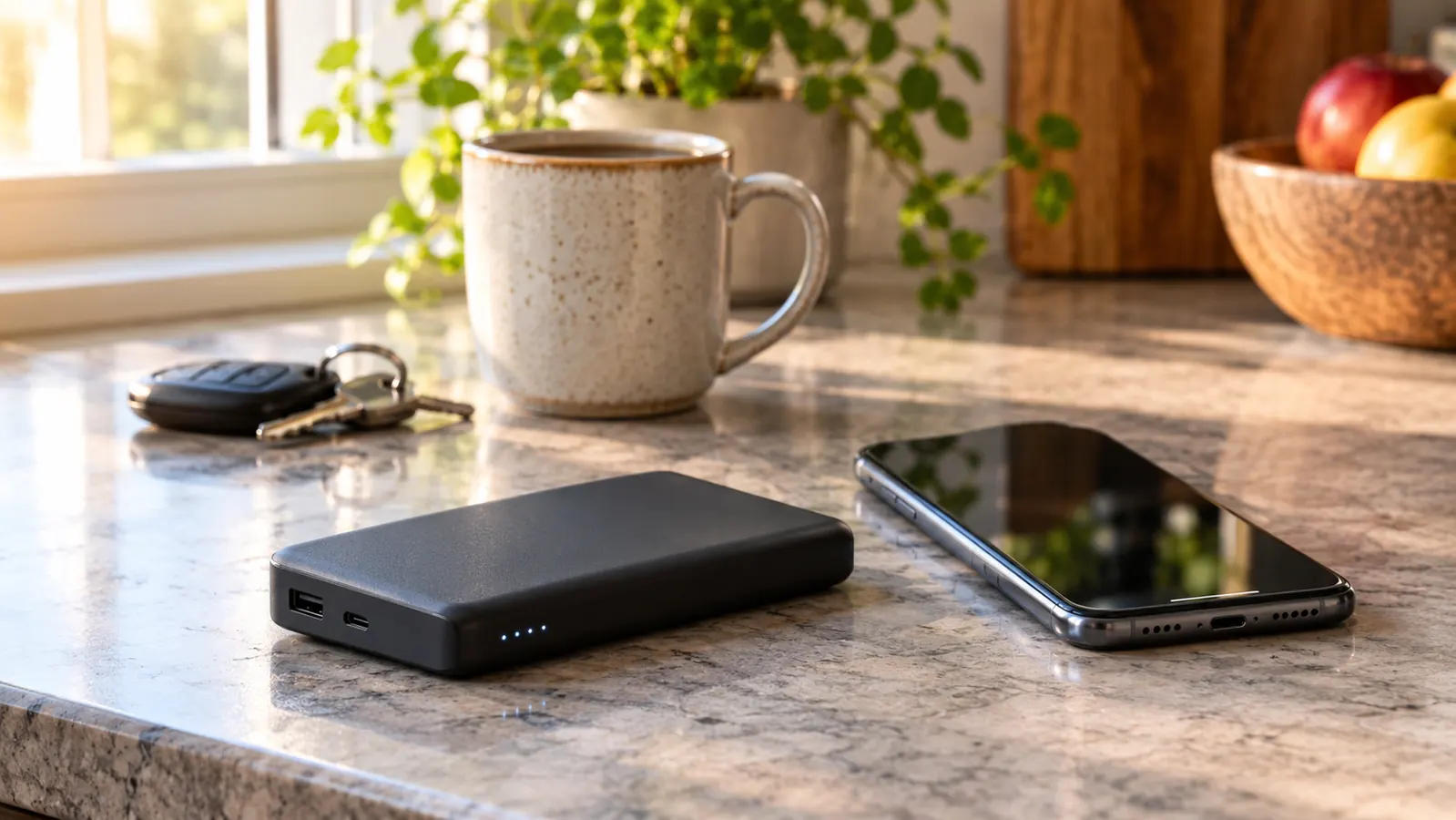
Carol and I drove down to see the grandkids last month, and somewhere around the halfway point my phone dropped to eight percent. No charger in the car. The one working outlet at the rest stop was already taken by a fella charging a laptop. I spent the last forty miles watching the battery icon and doing arithmetic in my head about whether I could call ahead before it quit on me. That drive is what made me start carrying a power bank. The one I settled on is the Anker 10,000mAh 30W, the model with the USB-C cable built right into the body, so there is no loose cord to lose in the bottom of a bag. It has been in my bag ever since.
I am not a gadget person. I spent a long career climbing poles and splicing cable for the phone company, and I like a tool that does one job without asking me to read a manual first. This bank is that kind of tool. It holds 10,000 milliamp hours, which is the capacity number, and it puts out 30 watts, which is the speed number. What follows is how I actually use it, in the order I actually do it, plus the parts of it that bother me, because there are a couple.
One bank, one attached cable, and no more arithmetic at eight percent
The Anker 10,000mAh with the built-in USB-C cable lives in my bag now. Today's price and the full listing are on Amazon.
Amazon Check Today's Price on Amazon →Step 1: Fill It the Night Before, Every Time
A power bank at half charge is not a backup. It is a heavy object in your bag that gives you false confidence. I learned this the ordinary way, by pulling mine out at a rest stop, plugging in, and watching the phone climb about twenty percent before the bank gave out. That was my own fault. I had used it the week before and never refilled it, and a battery that gets drained and put away empty is a battery that stays empty.
So the routine is now the same every Friday night before we go anywhere on the weekend. It sits on the kitchen counter next to my iPad, and I plug it into the same wall block I use for the iPad. It stays there overnight. By morning it is full, and I drop it in the bag and forget about it. The whole habit takes about four seconds of attention, once a week, and it is the difference between a working backup and a paperweight. If you take one thing from this article, take that one.
The reason the capacity number matters is that it tells you how much you get in a day. Ten thousand milliamp hours works out to roughly two full charges for a modern phone. That is not a big number next to the banks that advertise five or six, and I do not need it to be. Two charges covers a day of driving, a day at a doctors appointment, and time sitting in a parking lot waiting for Carol to come out of the grocery store.
Step 2: Reach for the Built-In Cable First
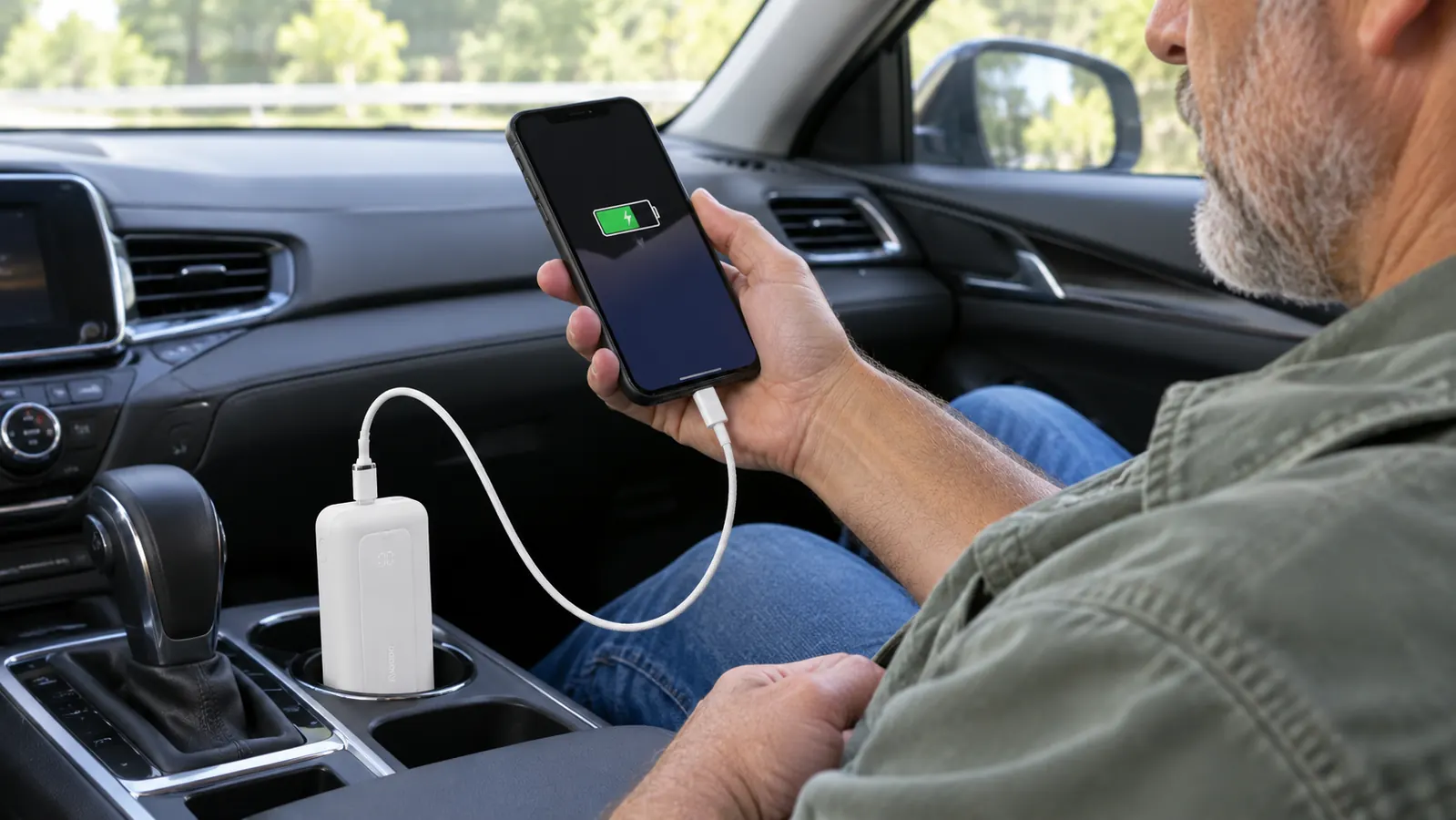
The reason I bought this particular Anker model, and the reason I would buy it again, is the cable that is already attached. It is a 5.4 inch USB-C cable that folds into the body, and Anker says it is tested to 10,000 bends. I cannot verify 10,000 bends in a few months of use, but I can tell you it does not flop around and it has not frayed at the joint where a normal cable always goes first. That joint is the reason I used to buy cables in three packs.
Before this, I carried a bank in one pocket and a cable in the other, and about one trip in four the cable stayed home. Then the bank is useless and I am borrowing a cord from a stranger at a gas station, which is not a habit I recommend at my age. Five and a half inches is also the right length. It is long enough to set the phone down next to the bank on a restaurant table. It is short enough that it does not turn into a knot in the bottom of the bag.
The one thing to know is that the built-in cable is the only cable that travels with me. If someone hands me an older phone to charge, the built-in cord will not fit it, and that is where the next step comes in.
Step 3: Put the Right Port on the Right Device
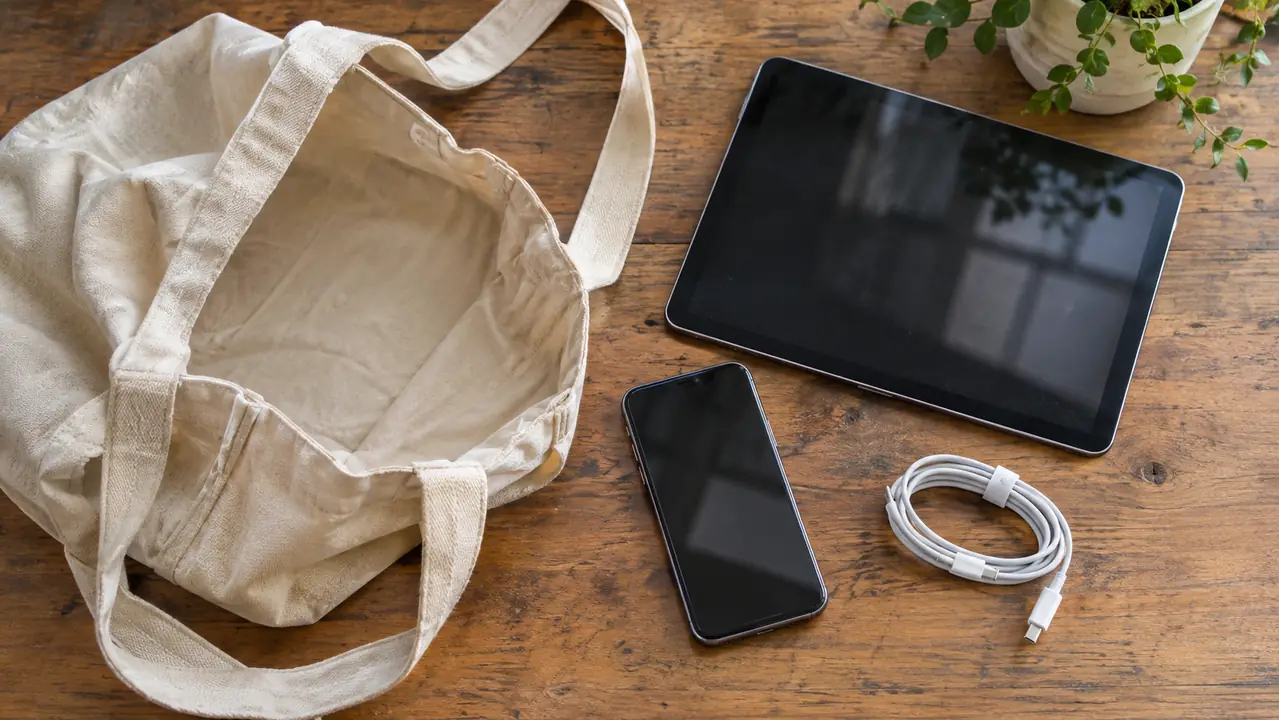
This bank gives you three ways to connect. There is the built-in USB-C cable, there is one USB-C port, and there is one USB-A port, the flat rectangular kind that older cords use. My iPhone goes on the built-in cable because it is the shortest path and I do not have to think about it. Carol's phone and the iPad get the USB-A port with one of the older cords I already had in a drawer.
Having those three connection points is what makes the bank useful past the first hour. On the drive down, I plug my phone into the attached cable, and the iPad goes into the USB-A port with a cord so the grandkids can watch what they want in the back seat without draining the tablet to nothing. Both of them charge. Neither one is in a rush, and on a two hour drive nobody needs it to be.
The speed number is where the 30 watts comes in. Anker rates this bank at twice the speed of a plain 5V/3A charger, and on my own phone I would put that at the difference between a slow top-off and a real charge. Twenty minutes on the built-in cable while I eat lunch gets me through an afternoon of phone calls and a couple of photos. That is the whole point of carrying it. I am not charging from empty to full mid-day. I am buying myself enough to stop worrying until I get home to an outlet.
The attached cable is the entire reason I stopped carrying a bank in one pocket and a cord in the other, and losing one of them about every fourth trip.
Step 4: Carry It Where Your Hand Already Goes
A charger you have to dig for is a charger you will not use. Mine weighs 223 grams, a bit under half a pound, which is about the heft of a paperback book. That is light enough to ride in the bag I already carry and heavy enough that I know it is there when I reach in. It goes in the same inner pocket every time, the one right next to my reading glasses. Same pocket, every trip, no exceptions, because the day I move it is the day I leave without it.
In the CR-V it lives in the little well between the front seats, next to the phone mount. That is not a storage decision, it is an access decision. When the phone drops below twenty percent at a stoplight, I want to reach down, plug it in, and be done before the light turns green. I do not want to pull over, open the back, and unzip a bag.
There is a second benefit to that spot, and it took me a while to notice it. Because the bank is in the car and not in a drawer at home, it gets used, and because it gets used, I notice when it is running low. A bank that lives out of sight is a bank that is always empty when you need it. Mine gets plugged in on Sunday night, and by Friday it has usually done some real work, which is exactly what I bought it for.
Step 5: Spend the First Charge, Save the Second
Two phone charges sounds like plenty until you spread them across two people and a tablet. The first charge goes early and without guilt. That is what it is for. If my phone is dipping on the drive down, it gets the built-in cable. If the grandkids want the iPad on the way to the park, the iPad gets the USB-A port. Nobody needs to ask permission for the first round.
The second charge gets saved for the ride home. That is the rule in our car and it is not up for discussion. The ride home is when you are tired, when you are more than an hour from your own outlet, and when the phone matters most because you may need to call somebody or check directions in the dark. I would rather have a full bank sitting idle for two hours than be at eight percent again at dusk on a highway.
This is the step most people skip, and it is the step that makes the first four worth doing. The bank is not a magic box. When the lights on the front stop showing a charge, the bank is done, and knowing that in advance is the difference between a useful tool and a disappointment. The Anker tells you where it stands with the indicator on the front. Look at it before you hand the iPad to a kid.
Where It Falls Short
The built-in cable is short by design, and when you are charging in the car and want to hold the phone up to look at something, five and a half inches runs out fast. I end up setting the phone down on the console. That is a small annoyance and a fair trade for not losing a cord, but it is a real limitation and you should know about it before you buy.
The capacity number is honest but modest. Ten thousand milliamp hours is about two charges, which is fine for a day out and not enough for a week in a hotel with no working outlet. If you are the sort who needs to charge a phone, a tablet and a hotspot for three days, this is the wrong size and you should look at a larger Anker bank. This one is built for a day at a time.
The last shortfall is that it is a phone and tablet charger. It is rated at 30 watts, and I would not count on it for a laptop. A fella at the rest stop with the laptop was plugged into the wall for a reason. I do not expect this bank to do a job it was not built for, and neither should you. For phones and a tablet it does exactly what it says. Anker backs it with an 18 month warranty, which I have not needed to use.
What Else Helps
Two small things make the whole routine work better. The first is a second short cable in the bag, USB-A on one end, because the built-in cord handles my phone and nothing else. The second is knowing your own devices. My iPad holds a charge much longer than my phone does, so on a short trip the iPad may not need the bank at all, and I can spend both charges on the phone. Carol's phone is the opposite. Learn which one of your devices is the greedy one and plan around it.
It also helps to plug in at the boring moments rather than waiting for the emergency. Ten minutes while you eat lunch, ten minutes while you sit in a parking lot, ten minutes at a red light. Small top-offs cost you nothing and they mean you are rarely the person asking a stranger for a cord. The people who run out of battery are almost always the people who waited until the phone was at four percent to do anything about it.
And if you have grandkids who borrow the iPad, tell them the rule before they get in the car, not after. Mine know the bank gets them home and the bank is not a toy. That conversation takes fifteen seconds and saves an argument two hours later on a dark road. It is the same principle as the jumper cables I keep in the back of the CR-V. You hope you never need them, and you would not leave the driveway without them.
None of this is complicated. Fill it up the night before. Use the cable that is already there. Keep it where your hand goes. Save the second charge for the ride home. The Anker 10,000mAh earns its spot in the bag because it makes those five steps easy to actually follow, and the attached cable is the reason I stopped leaving half of it at home.
The bank that stays charged because the cable stays attached
One 10,000mAh bank, one built-in USB-C cable, about the weight of a paperback. Today's price is on the listing.
Amazon Check Today's Price on Amazon →