
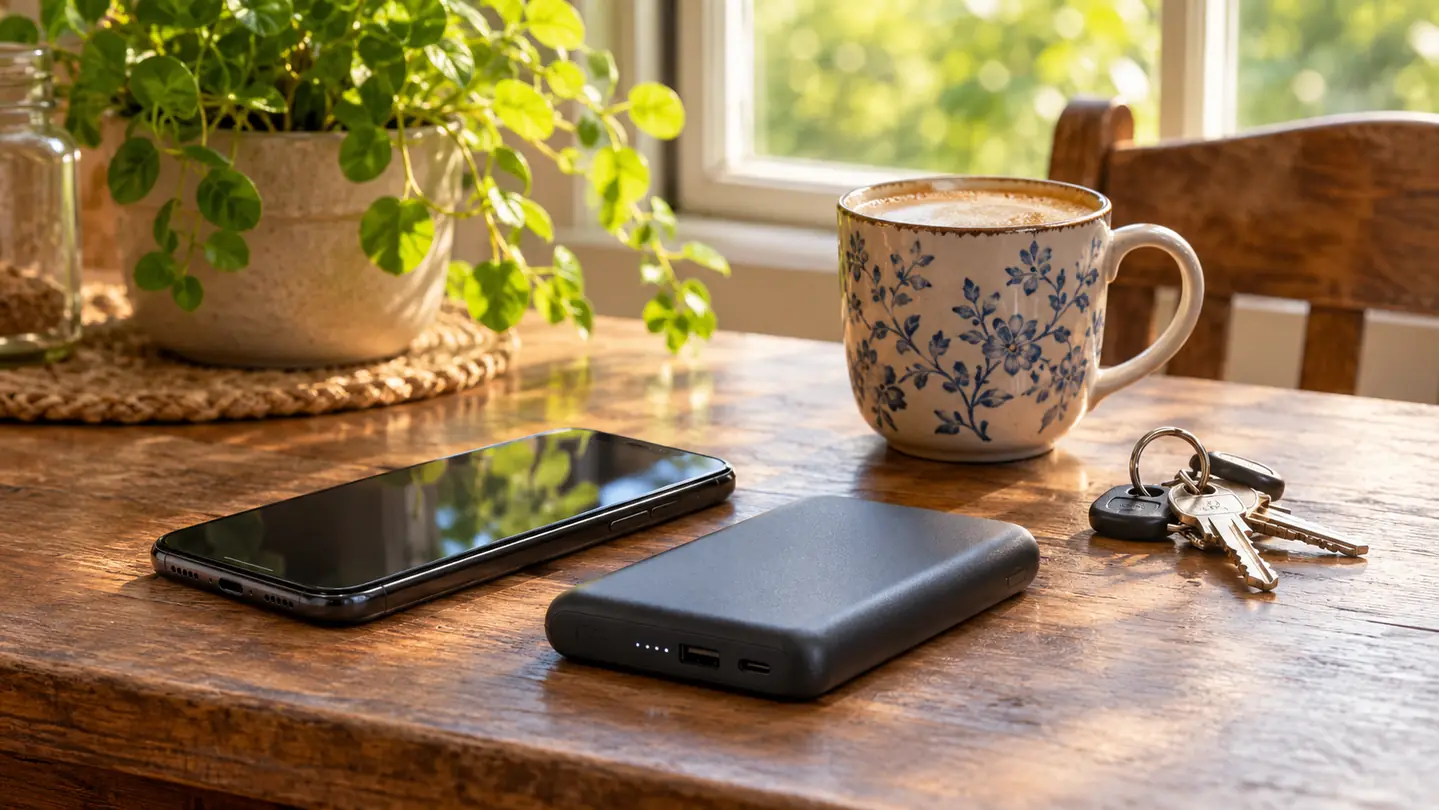
My iPhone has never run out of battery in my living room. It runs out in parking lots, in waiting rooms, and one Saturday in the aisle at the grocery store while Carol was reading a label and I was trying to find her. That is the whole reason I bought the Anker 10,000mAh power bank. Not because I wanted another gadget to keep track of, but because I got tired of watching the battery drop to 4 percent at exactly the wrong moment. I have carried this one in my jacket pocket, in the console of my Honda CR-V, and in a bag on the drive to my daughter's house for the better part of a year, and it has become one of the few things I notice when I leave it behind.
Here is what it is, in plain terms. It is a battery about the size of a thick deck of cards that stores 10,000 milliamp hours. Milliamp hours is just a way of saying how much charge a battery holds. A modern iPhone holds somewhere around 3,000 to 3,500 of them, so 10,000 works out to roughly two full phone charges once you allow for the small losses that always happen when power moves from one battery to another. Anker rates it at up to two full charges for an iPhone 15, and that is close to what I have gotten in practice.
The Quick Verdict
A small, honest battery that does the one job it promises, with a cable you cannot lose. It will not charge a laptop, and that short cable takes some getting used to, but for a phone it earns the space in your bag.
Amazon Check Today's Price →The Battery I Grab Before I Grab My Car Keys
10,000mAh, a built-in USB-C cable that cannot be left on the kitchen counter, and enough power for two full phone charges. It has stayed in my jacket since the day it arrived.
Amazon Check Today's Price on Amazon →How I've Used It
The routine is unremarkable, which is the point. The bank lives in the inside pocket of my jacket from October through April and in the console of the CR-V the rest of the year. I top it up on the kitchen counter every couple of weeks, usually Sunday evening while the coffee is still going. Carol has borrowed it twice, once for a dental conference and once when her own phone died in the middle of a call with her sister. Neither of us has had to think about it much, and for a piece of equipment that is the highest compliment I can pay.
One Thursday in February I spent an hour and forty minutes in a waiting room at the license bureau, and my phone was at 6 percent when I sat down. I pulled the cable out of its channel, plugged in, and laid the phone face down on my knee. By the time they called my number it was back up into the seventies. That afternoon is the reason the bank stopped living on the kitchen counter, where it had sat for the first two weeks I owned it, and started living in my coat.
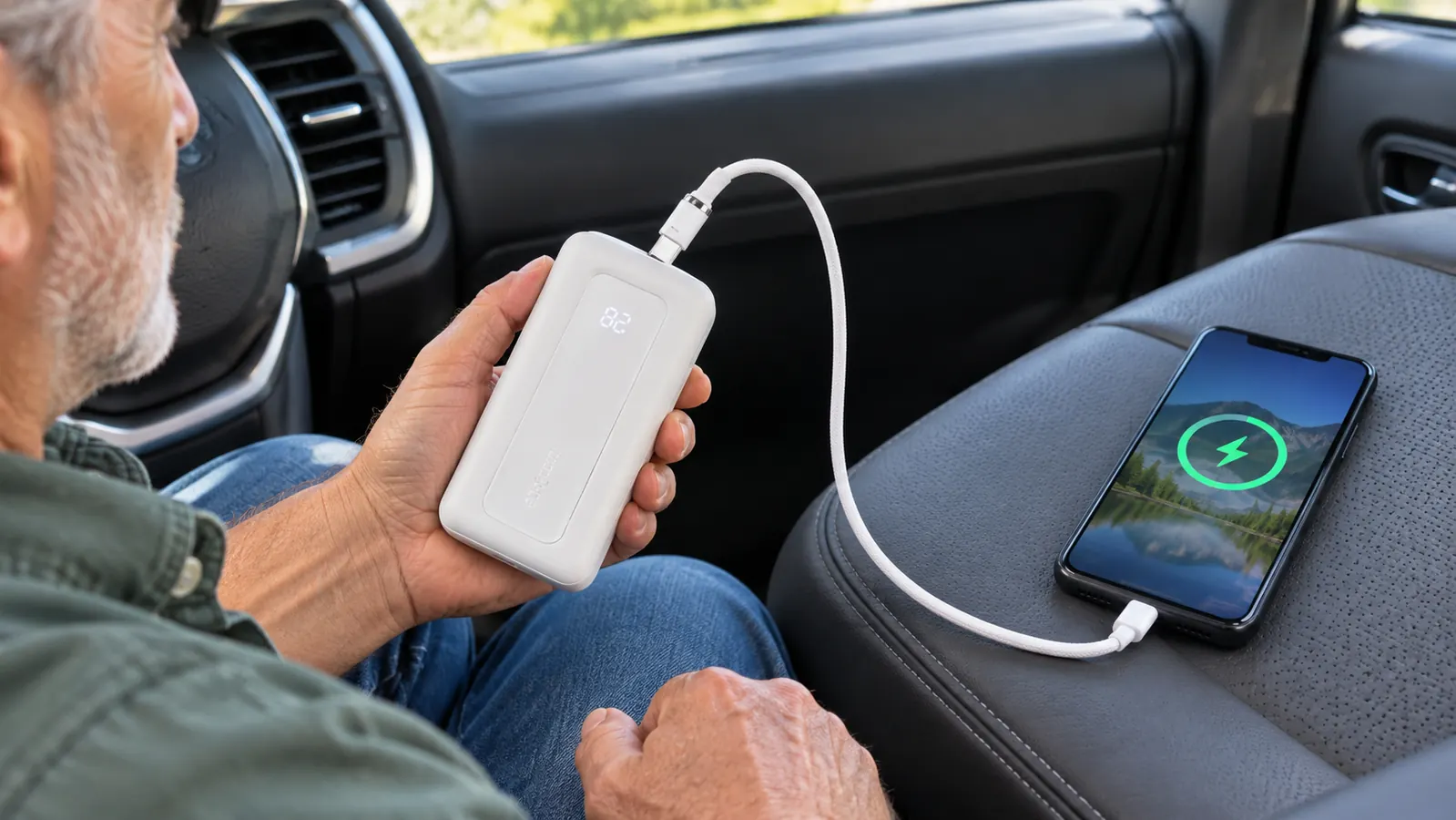
Charging a phone with it takes one motion. The USB-C cable is built into the body, so there is nothing to untangle and nothing to lose. That cable is 5.4 inches long, and Anker says it is tested to survive more than 10,000 bends. I cannot verify the number, but I can tell you that after months of folding it back into its slot, it still seats firmly and still charges at full speed. With my old battery I had to carry a separate cable, and I lost that cable twice. This one cannot be left behind, because it is attached.
The iPad is a different story. On weekend mornings the grandkids commandeer it for videos, and on Sunday afternoons I use it to call them when they are not here. The bank will put a partial charge into the iPad, enough to finish a call or get through one episode of whatever they are watching, but I would not plan on a full tablet charge from it. That is not really a flaw. Ten thousand milliamp hours is a phone-sized amount of power, and expecting it to run a tablet all afternoon is asking a garden hose to fill a swimming pool.
The Built-In Cable Is the Whole Reason to Pick This One
Most power banks are a brick with holes in it. You supply the cable, you forget the cable, you borrow a cable from a stranger at the fairgrounds. The Anker unit removes that whole failure mode. The cable is part of the device, it folds into a channel in the body, and it clicks back into place. If you have ever dug through a bag hunting for the right cord while your phone sits at 1 percent, you already understand why this matters more than any number printed on the box.
The other connections are sensible too. Alongside the built-in USB-C cable there is a USB-C port and a USB-A port, so there is a spare connection when a second device needs one. That is not something I use every day, but it bailed me out at church when a fellow usher's phone was dead and mine was not. Two ports and a built-in cable, on a battery that fits in a coat pocket.
The 30 watt output is the other half of the story. Thirty watts is roughly twice what an older 5 volt, 3 amp charger puts out, and in practice it means my phone goes from nearly dead to useful in about half an hour instead of an hour and a half. I am not going to quote you a stopwatch time, because it changes with how low the phone is and whether I am using it while it charges. But it is quick enough that I plug in at a rest stop and leave with a phone I do not have to worry about for the rest of the drive.
How Many Charges You Actually Get
Anker publishes specific numbers, which I appreciate. Up to two full charges for an iPhone 15, about 1.94 for a Samsung S24, two for an iPhone 14 Pro. My own count lines up. Starting from a full bank, I got two full charges on my iPhone with a little left over that was not enough for a third. That leftover is normal and I would not read anything into it.
That is the honest math of portable batteries. A battery rated at 10,000 milliamp hours does not hand 10,000 milliamp hours to your phone, because some of it turns into heat and some is lost stepping the voltage around. Every maker deals with the same physics, so treat the rated capacity as a rough ceiling and the published charge counts as the realistic promise. I have found the published counts to be accurate here, which is more than I can say for a few things I have bought over the years.
The clearest test came on a Saturday trip to my daughter's house, an hour each way with the map running on the screen the whole time. I started with the phone around half, plugged in on the way out, and never touched it again until we pulled back into my own driveway that evening. The bank finished the day with charge to spare, and I put it back in the console without giving it a second thought. That is the sort of day that used to leave me hunting for a wall outlet in somebody else's kitchen.
For my week, two charges is plenty. I fill the bank on a Sunday, carry it, and it is still holding most of its power the following weekend. If you are traveling and using maps all day, two charges is one good day of heavy use. If you are more like me and simply want a safety net in your pocket, it is closer to a week of not worrying.
Size, Weight, and Whether It Lives in Your Pocket
It weighs 223 grams, just under half a pound, and the body is compact enough to sit in a jacket pocket without pulling the whole coat sideways. I would not carry it in a trouser pocket all day. It is a little too thick and a little too heavy for that, and I think most people would agree once they hold it. A jacket, a bag, a glove box, a purse: all fine.
For the first month I kept it in the console of the CR-V next to a tire gauge and a couple of pens, and it slid around in there every time I turned a corner. I eventually put it in the side pocket of the driver's door instead, where it stays put and I can reach it without taking my eyes off the road. Small thing, but it is the sort of small thing you end up solving yourself with any battery.
The build feels solid in the way Anker products usually do. The case has a slight texture so it does not slide off a car seat, and the cable channel is snug enough that the cable stays put when I toss it in a bag. I have dropped it on the driveway twice and once on the kitchen floor. It still holds a charge and still seats the cable. The warranty runs 18 months, which is a reasonable stretch for something with a battery sealed inside.

What Months of Use Have Actually Changed
The honest answer is not much, and that is what you want. The case has a couple of scuffs on the corners from the driveway drop. The cable still folds back into its channel with a firm click, and the connection at the phone end is still tight rather than loose and wobbly the way cheap cables go after a few months. The printing on the back has worn a little where my thumb rests. None of that affects charging.
What has changed is my habit. I used to check my phone battery the way some people check the weather, and I do not do that anymore. The bank is either in my jacket or in the car, and if the phone gets low I plug it in for twenty minutes and stop thinking about it. That is a small thing in the grand scheme. It is also the only reason I bought the thing, so I count it as the review.
Where It Falls Short
The built-in cable is short. Five and a half inches means your phone and the battery have to stay close together, and if you are charging the bank from a wall outlet while also charging the phone, you end up with a small bundle of hardware sitting on the counter. It works. On a hotel desk it is fiddly. A longer cable would be more comfortable to live with, and a longer cable is exactly what you cannot have here.
The short cable is also worse in cold weather. On a January morning in a cold car the cable came out of its channel stiff and did not want to lie flat against the seat, so the phone kept sliding off the edge until things warmed up. Five minutes later it was fine. I mention it only because anyone in Ohio will meet the same morning, and it is not a defect, just the nature of a cable that lives outside.
The other limit is more fundamental. This charges phones, and that is essentially it. Anker lists smartphones as the compatible devices, and a 30 watt output is not going to run a laptop. If you want something to keep a Chromebook alive on a long flight, this is the wrong tool and you should be looking at a larger battery with a higher output. I also would not leave it in a hot car in July. That is true of every battery I have owned, but it is worth saying out loud.
What I Liked
- Built-in USB-C cable means there is nothing to lose or forget
- Two full phone charges from a battery that weighs 223 grams
- 30W output gets a dead phone back to useful in about half an hour
- Spare USB-C and USB-A ports when a second device needs a top-up
- 18 month warranty
Where It Falls Short
- The built-in cable is only 5.4 inches, so phone and battery stay tethered close together
- Nowhere near enough output for a laptop
- A little too thick and heavy for a trouser pocket all day
- Will not fully charge an iPad
Two full charges for my iPhone, from a battery that weighs 223 grams and sits in my jacket pocket without me noticing it is there.
Who This Is For
This is for the person whose phone dies at the worst possible moment and who is tired of planning around it. If you are on your feet at a grandchild's soccer game, in a hospital waiting room, on a bus, or anywhere there is no outlet within reach, this is the simplest fix I know of. It is also for anyone who has bought a cheap battery and had it quit inside a year. The Anker name has been reliable for me, and an 18 month warranty means you are not gambling much.
It suits older buyers especially, and I say that as one. There is nothing to configure. You pull the cable out of its channel, plug it into your phone, and it charges. That is the whole procedure. Carol figured it out in about four seconds, and she has never once asked me to set something up for her that did not need setting up.
Who Should Skip It
If you need to charge a laptop, skip it. Thirty watts and a phone-sized battery will not do that job, and you will be disappointed within an hour. If you routinely carry your phone in a front trouser pocket and want something you never notice, skip it too. At 223 grams this belongs in a jacket or a bag, not against your leg all day.
And if your phone only ever runs low at home or in the car, a plain cable and a car charger will do the same work and take up less room. This earns its place when you are away from an outlet, not when you are standing three feet from one.
If Your Phone Dies Where There Is No Outlet, This Is the Fix
10,000mAh, a built-in USB-C cable, and 30W output. Two full phone charges, nothing to configure, and a Sunday night top-up is the only maintenance it asks for.
Amazon Check Today's Price on Amazon →