

Last November I drove Carol to her sister's place over in Newark, and somewhere near the Route 161 exit my iPhone showed 8 percent battery. I had the directions up on the screen. Carol had the address written on the back of an envelope, and neither of us could make out her sister's handwriting in the dark. We got there. But I sat in that driveway afterward thinking about how much of my day now leans on a battery that quits by mid-afternoon.
The fix was an Anker power bank. The 10,000mAh one, with a USB-C cable built into the body, and it has lived in the console of the CR-V ever since. I am sixty-three. I spent thirty-one years climbing poles and splicing cable for the phone company, and for most of that career a telephone was bolted to a wall and had its own power supply. Now I'm the fellow in the family who gets handed the phones and tablets when something goes sideways. My iPhone. Carol's phone. The iPad I read on and video-call the grandkids with on weekends. I know what a dead battery does to a household, and it is not dramatic. It is a small grinding inconvenience that lands at the worst possible moment.
I tried the cheap route first, and I want to be honest about that. I bought a little power bank off a rack by the register at a hardware store. It gave me two good charges, then the port loosened up and it would only work if I held the phone at a particular angle. I am not going to sit in a parking lot holding a phone like a man tuning a radio.
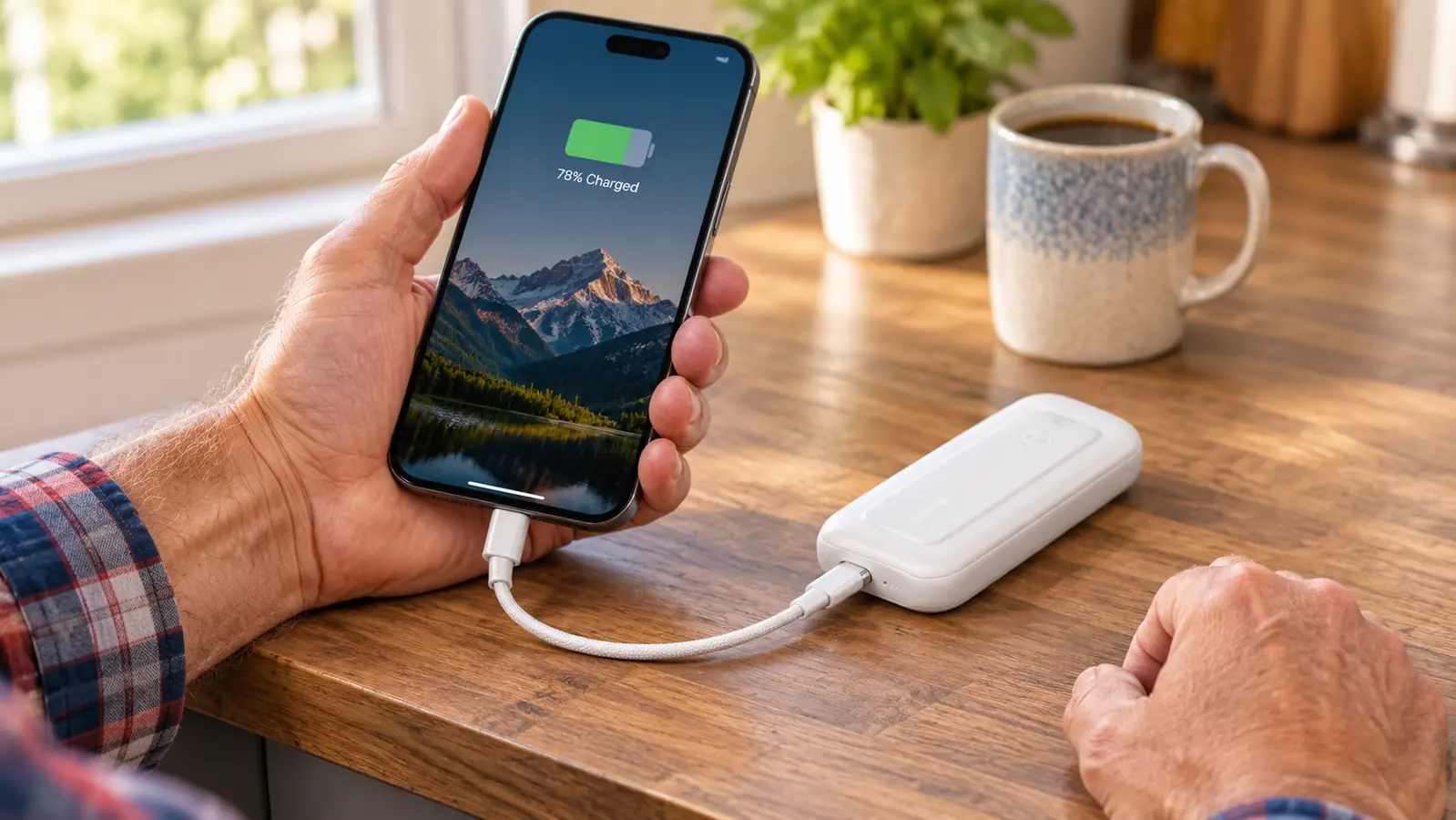
What sold me on the Anker was not a spec sheet. It was the cable. There is a USB-C cable folded into the body of the thing, 5.4 inches long, and the listing says it is tested to more than 10,000 bends. I have lost more charging cables than I care to admit. Between the car, the kitchen drawer and the bottom of my bag, they wander off. This one cannot wander off, because it is attached.
That is the whole reason it stayed in the car instead of going into the junk drawer with the first one.
Anker's own numbers say two full charges for an iPhone 15. From what I have seen in the CR-V, that is in the right neighborhood. Two days of my normal use.
Two charges in your pocket, and no cord to forget
The cable is built into the body and tested to more than 10,000 bends. That is the detail that keeps it in my console instead of in a drawer.
Amazon Check Today's Price on Amazon →Here is what it actually does in my week. Sunday morning it goes in my jacket pocket to church, because Carol and I leave the house at 8:40 and one of us always forgets to plug in the night before. It charges my iPhone at what Anker calls 30W, which they say is about twice as fast as the older 5V/3A chargers. I do not own a stopwatch. I can tell you that twenty minutes in the church parking lot after the service puts back more than I expect.
There was one afternoon in February that made the case better than I can. Carol's sister had a scare and we drove over. I was on the phone with the hospital's automated line, on hold, watching the battery drop one percent at a time, and I plugged into the bank and kept the call. Twenty-two minutes of hold music. Phone went from 11 percent to 46. That is it. That is the whole story. Nothing dramatic happened, and that is the point.

Anker's own numbers say it will do two full charges for an iPhone 15 and about two for an iPhone 14 Pro. From what I have seen, that is in the right neighborhood. On a normal week I top up once or twice and I charge the bank itself on Saturday night while Carol has whatever she has on the television. It weighs 223 grams, just over half a pound, and it sits in my jacket pocket without pulling it down.
The iPad is the other thing. When the grandkids visit on a weekend they will hand it back with the battery at nothing after watching videos, and I plug the bank into it and let it sit. There is a second port besides the built-in cable, one USB-C and one USB-A, so I can charge two things at once. It is not enough to run a laptop and I would not try. It is a phone-and-tablet tool.
Where it falls short. It has some heft to it. This is not the little credit-card thing you see in catalogs, and it will make a jacket pocket sag a little. Refilling the bank itself takes a while, a couple of hours from empty, and that is the part I forget. Twice now I have grabbed it off the counter on the way out and found it at half. That is on me and not on Anker, but it is the honest tradeoff: a power bank is only as useful as your memory to charge it. The built-in cable is also short on purpose, so if you want to use the phone while it charges, you are holding both together.
Warranty is 18 months according to the listing, which is longer than the year most of these come with, and it is the kind of thing you only appreciate when something goes wrong.
What I'd Tell You If We Were Sitting at My Kitchen Table
I would tell you not to buy one of these because it is a gadget. Buy it because you are tired of the small worry. The worry that the phone is going to quit while you are waiting on a call from the doctor's office, or while you are trying to find your way home from a part of town you do not know anymore. That is what a power bank is for at my age. It is not excitement. It is margin.
And I would tell you the cable matters more than the milliamp hours. Everybody sells milliamp hours. What you want is the thing you will not lose. That is why mine is an Anker and not a cheaper one with a loose port. If you want the longer account of how it has held up, or how it stacks against the other brand folks ask me about, both are worth a read before you spend anything.
Margin, for the price of a paperback and the weight of one
Built-in USB-C cable, 10,000mAh, 30W charging, 18-month warranty. It rides in my console and I stopped thinking about battery percentage on the way home.
Amazon Check Today's Price on Amazon →