
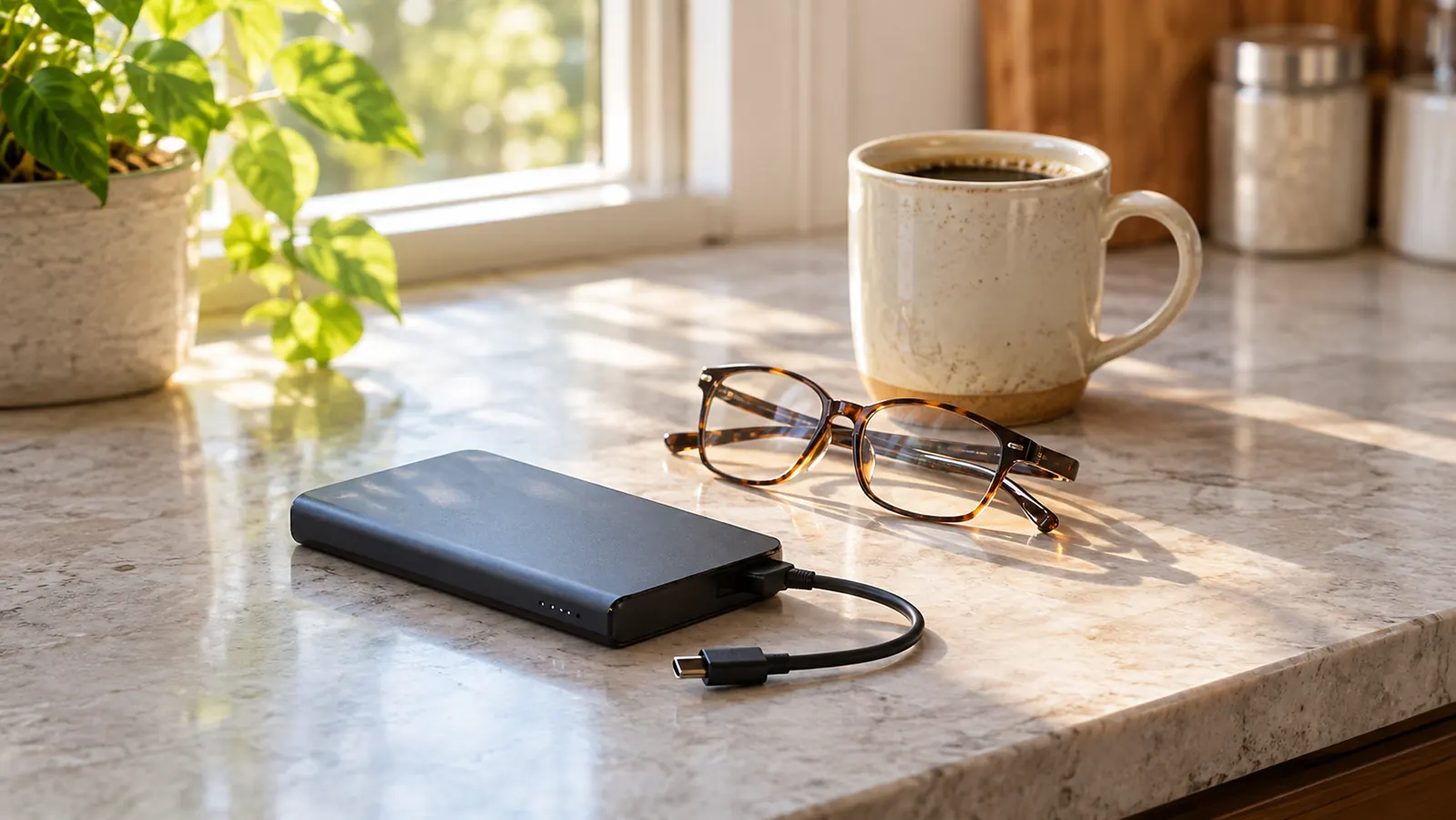
Anker built the charging cable into this one, and that single decision is why it rides in my bag instead of living in a drawer. I am 63. I carry one phone and one iPad. I have lost more charging cords than I can count, most of them left behind in a waiting room or a rental car. When my daughter handed me this 10,000mAh Anker power bank and told me the cord was attached to the body, I cared about that detail more than I cared about the battery size.
This is not a review that tells you the thing will change your life. It is the review I wanted while standing in an aisle holding a box, trying to work out whether what was inside would help me or just add weight to a bag I already carry. I have used it since the spring. Here is what it does well, where it annoys me, and who I would tell to walk away from it.
The Quick Verdict
A well-made 10,000mAh battery with a cable that cannot get lost. If your phone charges over USB-C, it is the simplest battery I have owned. If it does not, most of what makes it special does not apply to you.
Amazon Check Today's Price →The cord is already in the bag. That is the entire argument.
Anker rates it at 30W, twice the speed of the older 5V/3A chargers, and lists up to two full charges for an iPhone 15. The built-in USB-C cable is tested to 10,000 bends, and the whole thing weighs 223 grams.
Amazon Check Today's Price on Amazon →How I've Used It
The routine is dull, and dull is the point. Sunday night I plug it into the wall block I use for my phone and leave it on the counter overnight. Monday it goes into the bag I take to church and then to the grocery store. Wednesday it comes with me to my daughter's house, where the two grandkids borrow the iPad for their video call and never once think about whether the thing has any charge left in it.
The day it earned its place was not dramatic. Carol and I sat in a hospital waiting room for a little over three hours while a friend had a procedure done. I read on the iPad. She read on her phone. Both devices were below thirty percent when we walked out, and neither of us went hunting for an outlet in a hallway. That is the whole value of a power bank. It sounds like nothing until you are the one in the chair.
I also noticed the weight, or rather I stopped noticing it. Anker lists 223 grams, which is a little under half a pound. By the second week it had disappeared into the bag the way a good umbrella does, present but not on your mind. The battery you actually carry is the battery that helps you. The heavy one stays on the counter at home.
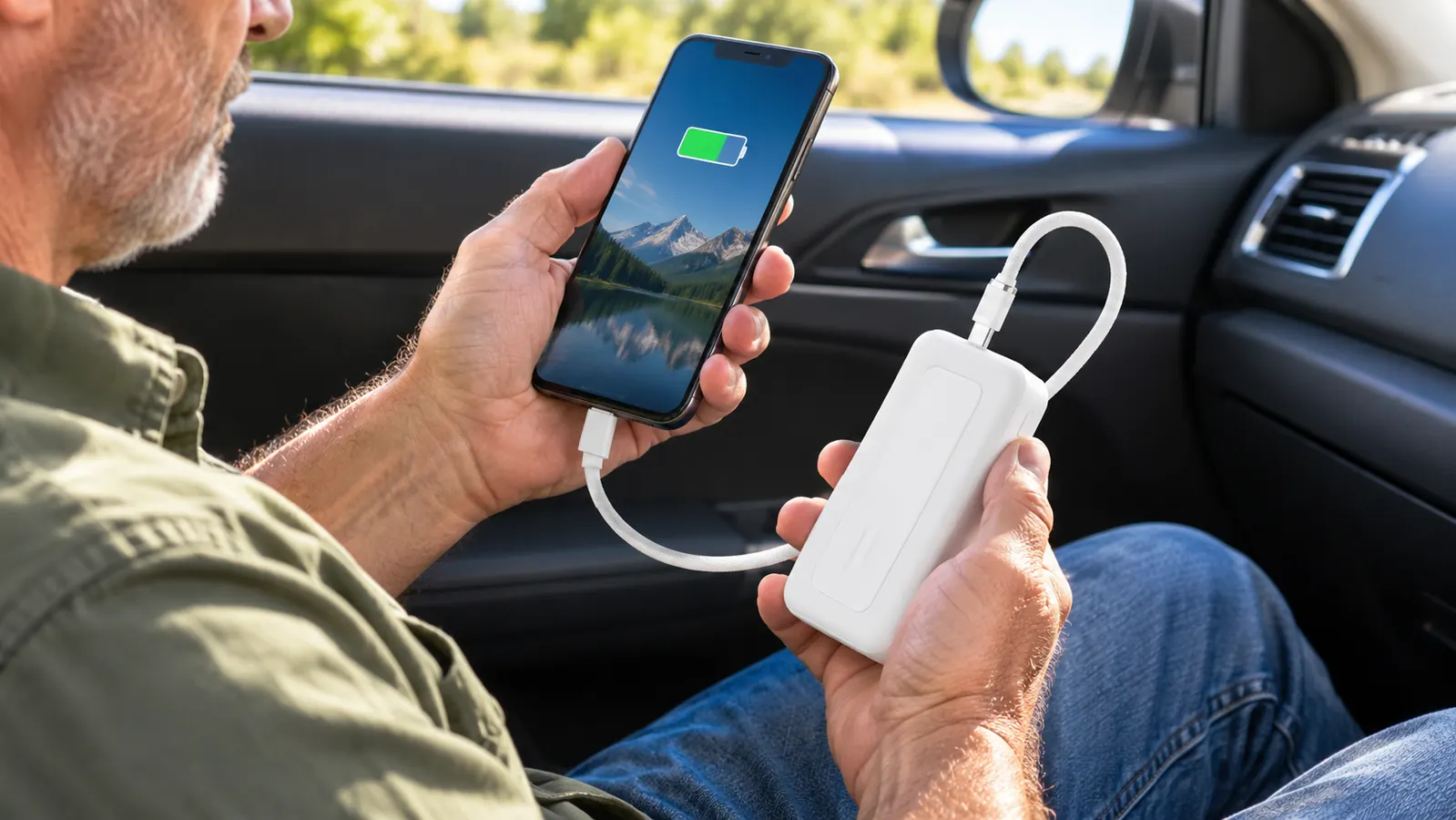
One more use, and this is the one I did not expect. The CR-V sits in the church lot for an hour after the service while Carol talks to people, and I have taken to topping my phone up there in the driver's seat instead of at home. The built-in cable reaches from the cup holder to my hand without any fuss. Small thing. It is the small things that decide whether a gadget stays in the bag or gets left on the counter.
What Anker Gets Right
The speed is real, and it is the part that changes how you use a phone. Anker lists 30W and calls it twice as fast as the 5V/3A chargers that were common a few years back. In kitchen table language: the phone goes from nearly dead to around half in about half an hour. I did not sit with a stopwatch, but I did stop planning my morning around which coffee shop has a free outlet.
The capacity numbers held up for me. Anker prints up to two full charges for an iPhone 15, 1.94 charges for a Samsung S24, and two charges for an iPhone 14 Pro. I got two charges on my phone with a little to spare, which is what a 10,000mAh battery should give once you allow for the power lost moving energy from one battery into another. That loss is normal. Every bank does it and almost nobody prints it on the box.
The build is what you would expect from a company that has made a great many of these. The case is solid. The connector seats with a firm click. Nothing rattles when I set it down on the counter. Anker is not a name that turns up in the discount bin at the gas station, and this does not feel like a corner was cut to hit a price.
Reliability over four months has been the quiet part. It has never failed to start charging. It has never gotten hot enough to worry me, just warm the way any battery gets warm. It has ridden in a bag through a Columbus summer and sat in a cold car in early spring, and neither seemed to bother it. That is not exciting, and it is exactly what I want from a battery.
Anker also lists an 18-month warranty. That is not forever, but it is longer than a lot of small electronics get, and on a product whose main feature is a cable that flexes every time you use it, that coverage is the part I care about most.
Two full charges on my phone, a firm click at the connector, and no rattle when I set it on the counter. That is what I checked for, and that is what held.
Where It Falls Short
Here is the part the listing does not put in big letters. The cable attached to this bank is USB-C, and that cable is the feature. If your phone charges over USB-C, you are set. If it does not, you are carrying a battery with a permanently attached cord you will never plug into anything. Carol's phone takes a different connector, so she uses the ports on the body with her own cord. That works fine. It is just not the product she would have picked off the shelf for herself, and I think Anker should say so more plainly on the box.
Filling the bank back up is the slow half of the relationship. I plug it in Sunday night and it is finished by morning. If you are the sort who remembers at seven in the morning that you need it at nine, this will not rescue you. Plan around it the way you plan around charging anything else, and it stops being a problem.
Plug in two devices at once and both charge more slowly. I had my phone and the iPad on it in the waiting room and both crept upward. They got where they needed to go. It was simply not the fast charge I get with one device connected.
The attached cable is 5.4 inches, which is right when you are holding the phone and the battery in the same hand, and awkward for anything else. If you want the phone on the nightstand and the battery on the floor, you will be using your own longer cord and the built-in one becomes dead weight.
The marketing language is a small irritant too. The box calls it a travel essential, which is the kind of phrase that means nothing once you get it home. It is not a travel essential. It is a battery with a cord on it, and it happens to be a good one. I would rather be told the plain truth than a slogan.
And the honest limit: this is a phone and tablet battery. I would not expect it to run a laptop and I would not ask it to. There are larger, heavier banks for that job, and you pay for the privilege in weight in your bag every single day.
What I Liked
- Built-in USB-C cable tested to 10,000 bends, so there is nothing to lose or forget
- 30W charging, described by Anker as twice the speed of older 5V/3A chargers
- Delivered two full phone charges for me, matching Anker's own printed figures
- 223 grams, light enough that I stopped noticing it in the bag
- Solid case, firm connector click, and an 18-month warranty
Where It Falls Short
- The built-in cable is USB-C only, so it does nothing for a phone on another connector
- The 5.4-inch attached cable is stingy for nightstand use
- Charging the bank itself means planning ahead overnight
- Two devices at once means slower charging for both
- It is a phone and tablet battery, not a laptop battery
What 10,000mAh Actually Means
The number on the box is not the number that reaches your phone, and nobody explains this at the counter. A 10,000mAh rating describes the battery inside the case. Moving that energy into a phone costs some of it, mostly as heat, so what you can actually use is closer to two thirds or three quarters of the printed figure. This is true of every brand on the shelf. It is not an Anker problem and it is not a defect.
That is why Anker's own charge counts say two full charges for an iPhone 15 rather than three. They are doing the honest arithmetic on the outside of the box, which I appreciate now that I understand it. If you see a battery advertising 10,000mAh and promising four phone charges, somebody in the marketing department is being generous with the truth.
The practical version is this: treat it as a two day battery for a phone, or one good long day for a phone and a tablet together. That is what I plan around now, and it has not left me stranded yet.

The Built-In Cable, Four Months In
Since the cable is the reason to buy this, it deserves a straight accounting. Anker rates it to survive more than 10,000 bends. I cannot bend a cable ten thousand times to check, but I can tell you what four months of daily handling looks like. The jacket at the hinge is still even. The connector still clicks into the phone. It has not developed that soft spot near the base that tells you a cord is on its way out, and that soft spot is how every cable I have ever owned has died.
What it removes is the real benefit. No cord in the bag. No cord borrowed and never returned. No standing in a parking lot asking a stranger whether they have a charger. For a man who has bought the same cable four separate times because he kept leaving them behind, that is worth more than the milliamp hours.
The tradeoff is plain and I will not pretend otherwise. If the cable fails, the best feature fails with it. That is exactly why the 18-month warranty matters more here than it would on a plain battery. Keep the paperwork in the drawer. If the hinge starts acting up, use the coverage instead of shrugging and buying another one.
The Short List I Would Hand Anker
If I could hand the engineers a note, it would be short. I would ask for the attached cable to be a couple of inches longer, since 5.4 inches is generous at the hand and stingy on a nightstand. I would ask for an adapter so the same built-in cable could serve a phone that uses a different connector, which would widen the number of people this thing actually helps. And I would ask them to keep it in this weight class, because 223 grams is the number that keeps it in my bag instead of on my dresser.
Who This Is For
This is for the person whose phone charges over USB-C and who is tired of managing cords. It is for the reader who wants one object in the bag rather than two, who charges a phone and maybe a tablet and never a laptop, and who wants the battery light enough to forget about until the day it is needed. If you are in your sixties or seventies and you want something you can hand to a grandkid without a single instruction, this is close to ideal. The cord is attached. There is nothing to figure out. That is not a small thing at our age, and I wish more products were built with it in mind.
Who Should Skip It
Skip it if your phone does not use USB-C. You would be paying for a cable that does nothing for you, and a plain battery with an open port would serve you better. Skip it if you want to run a laptop on the road, since this is not that tool. Skip it if you need to charge two devices at full speed at the same time, or if you want a long cable, because 5.4 inches is what you get. And skip it if you know you will not plan ahead on charging the bank itself. This is a good product with clear limits, and the people it fits will be glad they bought it.
The bottom line, after four months: I would buy this again, and I would buy it for the reason my daughter gave it to me. Not the capacity, not the speed, not the numbers on the box. The cord is already there. For a 63-year-old man who has spent a small fortune replacing lost charging cables, that is the whole review in one sentence.
If your phone is USB-C, this is an easy call.
10,000mAh, 30W charging, a built-in USB-C cable rated for 10,000 bends, 223 grams, and an 18-month warranty. Check today's price before your next road trip and stop hunting for outlets in waiting rooms.
Amazon Check Today's Price on Amazon →