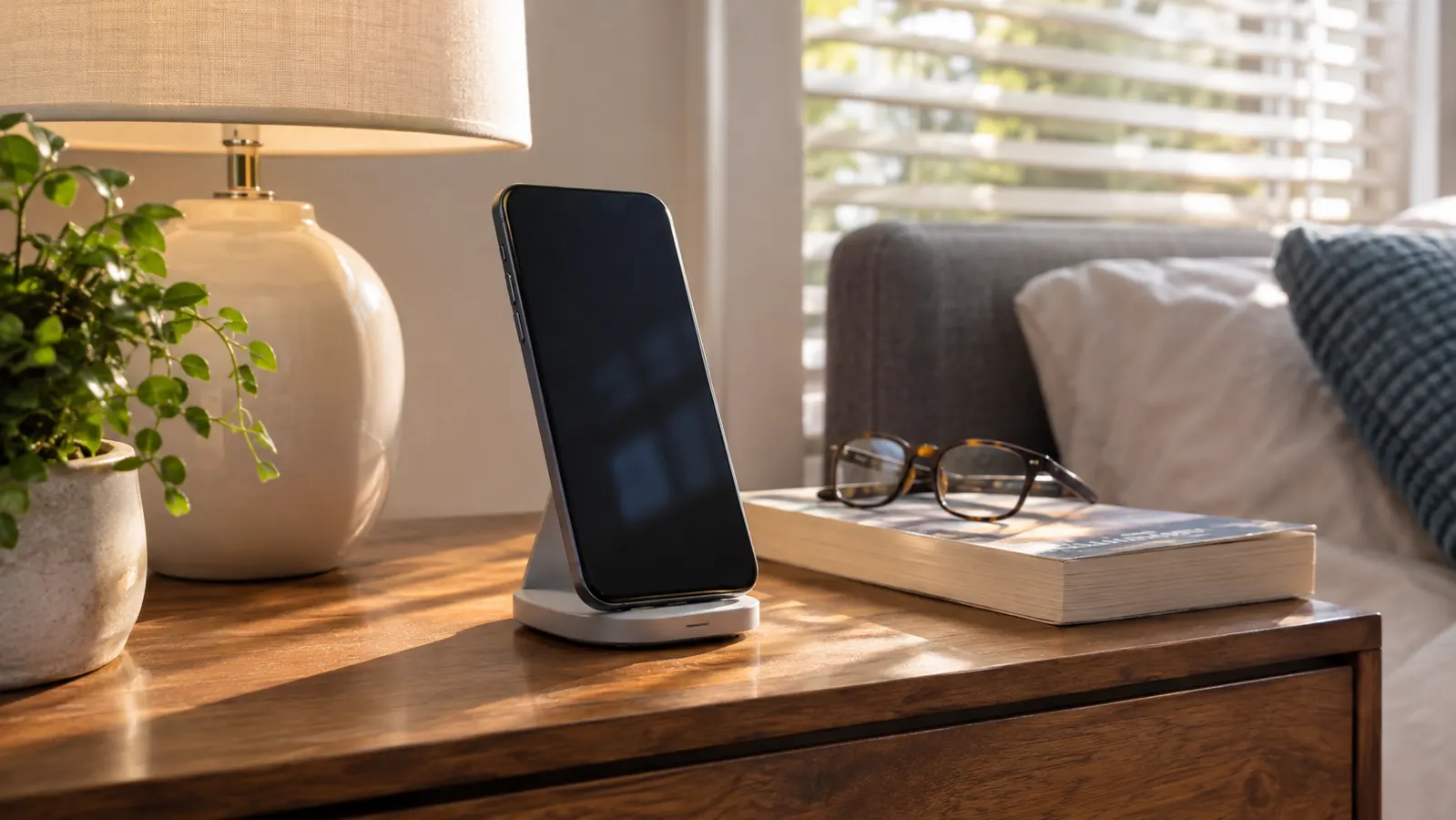
I bought the Anker 313 wireless charger stand for a plain reason. Every night I would set my phone down on the nightstand in the dark, miss the charging port, and drag the phone half off the table by its cord. Carol told me to just leave the lamp on. I told her a stand that holds the phone upright sounded easier than aiming a plug in the dark. So I ordered one, set it on the nightstand, and I have used it every night since. This is not a love letter. There are three things about this charger that the product page does not put in big letters, and one of them nearly had me boxing it up in the first week.
Here is the plain description first, because half the confusion about wireless charging comes from people expecting something they were never sold. The Anker 313 is a small upright stand, 3.84 ounces, that charges a phone by setting it against the front plate instead of plugging a cable into it. It is Qi certified, which means it follows the same charging standard most phones have used for years. It tops out at 10 watts for Samsung Galaxy phones and 7.5 watts for iPhones. It charges through cases up to 2.5 millimeters thick, provided the case is plastic, rubber, or TPU. That is the whole product. Everything else is how it behaves in a house.
The Quick Verdict
A steady, simple stand that does its one job well, once you put a 9 volt 2 amp adapter behind it and accept a Micro USB cable.
Amazon Check Today's Price →Set the phone down and walk away, no cord to find in the dark
Qi certified, 7.5W for iPhone and up to 10W for Galaxy, charges through cases up to 2.5 mm thick. Bring your own 9V 2A adapter and it is full by morning.
Amazon Check Today's Price on Amazon →What the Listing Buries
The first thing the listing buries is that no wall adapter comes in the box. What you get is the stand, a three foot Micro USB cable, and a welcome guide. That is it. If you do not have a 9 volt, 2 amp adapter already sitting in a drawer, you will plug this into whatever old phone brick you have around, and it will charge slower than the stand is able to. Anker states the requirement in the listing. It is remarkable how many complaints could have been avoided by putting that sentence on the front of the box.
The second thing is the connector. Micro USB, not USB C. In a house where every other device I own has finally settled on the newer oval plug, this is the one cable I have to keep track of separately. It works. It clicks in and it stays. The included cable is three feet, which is right for a nightstand and short for just about anything else. If you plan to move the stand between rooms, plan on a second cable, and know that Micro USB cables are already the ones you cannot find at the checkout counter.
The third thing is the one that almost sent it back. It is not a fast charger in the sense most people mean today. 7.5 watts for an iPhone is real charging, but it is slower than a cable. Set a phone on it at eleven at night with a low battery and it will be full by morning, without any fuss. Set it there for twenty minutes while you eat lunch and you will get a top up, not a fill. If you are used to a cable that adds half a battery while you make a sandwich, this will feel slow. That is the trade for not plugging anything in.
How I've Used It
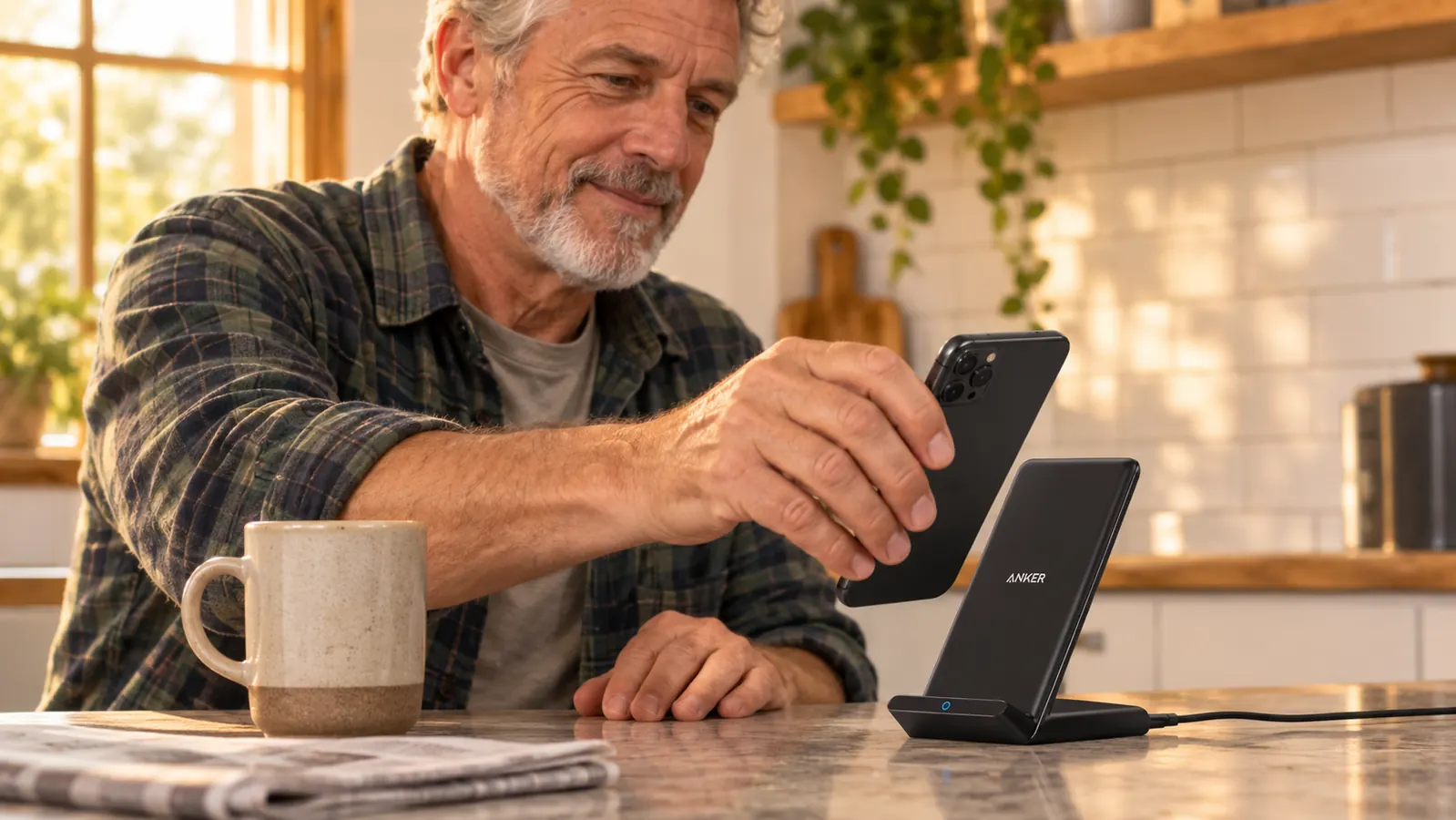
The stand has lived on my nightstand since the day it arrived, and that is its natural home. I set the phone against it, the screen faces me, and in the morning I read the weather and the headlines without picking the phone up. When I want to watch something, I turn the phone sideways and the stand holds it in landscape, which I did not expect to use as often as I do. Carol charges her phone on it while she gets ready in the morning. Her case is a thick rubber one and it charges straight through it, which surprised me more than it should have.
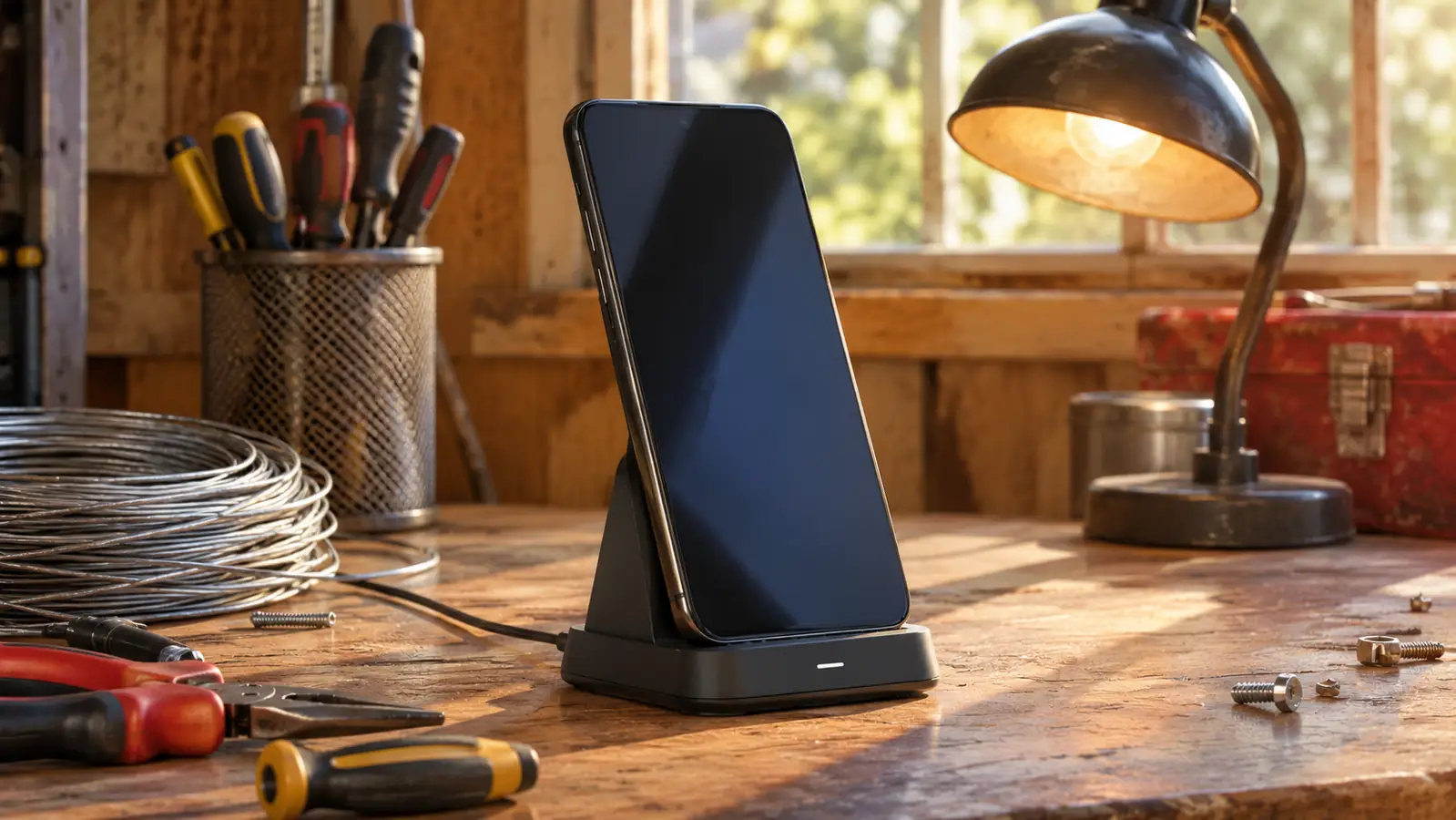
I tried it in the kitchen next, and there it earned its keep in a different way. I cook with a phone nearby for timers, and having it propped up and charging instead of lying flat with a cord dragging through the flour was a small, real improvement. It spent a month on the workshop bench while I was rebuilding a lamp, and the upright angle was handy there too. At just under four ounces it is light enough that carrying it from room to room is not an event, and it stays where I set it down rather than skating across the counter.
One limit worth saying plainly, because it comes up whenever a friend asks about this thing. It is a phone charger. It charges a phone. The iPad stays on its own cable, since a tablet does not sit on a pad like this. If you want one device that charges a phone and a watch and a tablet at the same time, this is not that device. It is one stand, one phone, one job. That is not a complaint. It is just what the thing is.
The Adapter Question, in Plain Terms
A wall adapter, in case the term is fuzzy, is the little block that goes into the outlet. Your phone came with one, or maybe it did not, depending on how recently you bought it. The Anker 313 needs a 9 volt, 2 amp adapter to reach its rated charging speed. That is the brick that came with a phone from a few years back, not the tiny one from a decade ago. Plug the stand into an old 5 volt adapter and it will still work. It will just work slowly, and most people blame the stand for that when the adapter is the bottleneck.
This is the most common misunderstanding I have run into. A neighbor two doors down bought one, plugged it into the adapter from an old flip phone, and told me the following week that wireless charging was a gimmick. We swapped in a proper 9 volt, 2 amp block and it went from barely gaining a charge overnight to being full every morning. Nothing about the stand changed. The adapter did. If you are going to buy this, find the right brick first, or order one along with it.
The included cable is three feet, which reaches from a nightstand to the outlet behind it and not much further. On a desk, three feet runs out fast if the outlet is under the far side of the furniture. That is a measurement more than a design flaw, and it is worth taking before you buy instead of after. I measured mine. It mattered.
Micro USB, and Why It Still Bugs Me
I spent thirty one years as a lineman for the phone company, and I have a long history with connectors. I have watched good equipment get retired because the plug on it stopped being made. The Micro USB connector here is the one thing I would change if I could change one thing. It works fine. It seats firmly and it has not come loose on mine. But it means one more cable to keep track of in a house that has finally settled on USB C for everything else.
In practice this matters twice. Once when you misplace the cable, and once when you want a second cable so the stand can live in two places. A longer Micro USB cable is easy enough to find today. I would not count on that staying true. It is a small thing and it does not change how well the stand charges. It is the kind of detail that only shows up in year three, when you are digging through a drawer looking for the one plug that fits.
Cases, Alignment, and the Two Millimeter Rule
The stand charges through cases up to 2.5 millimeters thick, and Anker names the materials it is rated for: plastic, rubber, or TPU. Carol's thick rubber case charges without complaint and so does a thin plastic shell. Where people get into trouble is with a case so bulky that the phone never sits flush against the front plate, or a wallet case with cards in it that holds the phone off the surface. Wireless charging is fussy about distance in a way a cable never is. A quarter inch of air is the difference between charging and not charging.
Alignment matters more than I expected. The coil in the phone has to sit over the coil in the stand. On a flat pad you can set the phone down crooked, walk away, and come back to a phone that only gained a little. The upright shape does the aligning for you, which is a real advantage I did not appreciate until I lived with it. Slide the phone up too high and it will not charge, so the first week is trial and error while you learn exactly where it wants to sit. After that you stop thinking about it.
Speed, Warmth, and What 7.5 Watts Feels Like
Seven and a half watts for an iPhone, ten for a Galaxy. Those numbers look small next to the fast charging figures printed on new phones, and they are small. This is a charger built for the hours you are asleep or at your desk, not for the twenty minutes before you walk out the door. The honest description is that it does not impress you and it does not fail you. Every morning my phone is full. In more than a year of nightly use it has not once left me with a dead phone at noon.
The back of the phone is warm when I pick it up in the morning. Not hot. Warm, the way a phone is warm after a long call. That is normal for wireless charging, since some of the energy turns into heat instead of into the battery. I have never had a phone shut down or refuse to charge on it. In July I take the phone out of a heavy case anyway, out of caution rather than because anything went wrong. If you want the fastest, coolest way to charge a phone, a cable wins. This is the easiest way.
The Case for the Stand
The reason I keep it is simple. It removes a daily decision. With a cable, every night is a small negotiation: find the cord, hold the phone still, wait for the buzz that says it connected. Maybe once a week I would knock the cord loose in the night and wake up to a phone at forty percent. With the stand, the phone goes on the stand. That is the whole ritual. For someone who does not see well in a dark bedroom, that is not a small convenience. It is the difference between a charged phone and a dead one.
It also holds the phone at an angle that makes it useful while it charges, which a flat pad never does. I answer calls on it. I watch a grandson's ballgame, streamed sideways, propped and charging. I read the news before bed. None of that happens with a phone lying flat on a cable. You could argue that a cable plus a separate stand does the same job, and you would be right, but then you own two things instead of one.
What I Liked
- Charges as soon as the phone touches the plate, no plug to aim at in the dark
- Holds the phone in portrait for reading or landscape for video while it charges
- Charges through plastic, rubber, or TPU cases up to 2.5 mm thick
- Qi certified, so it follows the same standard most phones already use
- Light at 3.84 ounces, easy to move between nightstand, kitchen, and workbench
- 18 month warranty and a 3 foot Micro USB cable in the box
Where It Falls Short
- No wall adapter in the box; needs a 9V 2A adapter to reach its rated speed
- Micro USB connector in a house full of USB C devices
- 3 foot cable is short for a desk or a far outlet
- 7.5W for iPhone is slower than charging on a cable
- The phone is warm in the morning, as with all wireless charging
The adapter is the bottleneck, not the stand. Put a proper 9 volt 2 amp brick behind it and it goes from barely charging overnight to full every morning.
Who This Is For
This is for the person who charges one phone in one place overnight and wants to stop fiddling with a cord. Nightstand, desk, kitchen counter. If you set the phone down at roughly the same time every night and pick it up at roughly the same time every morning, the stand fits that habit like a glove. It suits people who watch video while the phone charges, because the upright angle is the whole point. And it suits anyone whose eyes are not what they used to be. You feel the phone seat against the plate and you walk away.
It also suits a two phone household, as long as you charge at different times. Carol charges hers in the morning over coffee and I charge mine overnight. One stand has covered both of us for more than a year. If we both needed it at the same hour we would need two of them, and that is worth knowing before you buy rather than after.
Who Should Skip It
Skip it if you do not have a 9 volt, 2 amp wall adapter and do not want to buy one. The stand will run on a lesser adapter, but it will run slowly, and you will blame the stand for it. Skip it if you need to charge a tablet or a watch at the same time, because it charges one phone and nothing else. Skip it if you charge in short bursts of ten or fifteen minutes, since a cable will beat it in that race every single time.
And skip it if you want the newest connector in the house. The Micro USB plug means a separate cable to keep track of, and if that sort of thing will irritate you at nine at night, buy a stand with USB C instead. I would rather tell you that now than have you find it out in a drawer in three years. The stand is good at what it does. It is not good at everything, and no product is.
The Honest Summary
The Anker 313 has sat on my nightstand for more than a year and I have no plan to replace it. It charges my phone every night without complaint, it holds the phone where I can read it, and it stopped being a source of aggravation the moment I put the right adapter behind it. There is no drama to it, which is the highest compliment I can pay a piece of equipment that lives beside a bed. If you want speed, buy a cable. If you want to stop plugging a phone in at night, this does that one job reliably.
One stand, one phone, full every morning
Qi certified with portrait and landscape viewing, 7.5W for iPhone and up to 10W for Galaxy. Check the adapter drawer first, then check today's price.
Amazon Check Today's Price on Amazon →